Thousands of CX leaders gathered at CCW Vegas to discuss what’s next for contact centers. Here’s what stood out and why we believe workforce development has entered a new era.
The Theme Nobody Announced But Everyone Was Talking About
Every year, CCW gives the industry a snapshot of where customer experience is heading. Some years, the conversation revolves around new technology. Some years it’s cost reduction. Others it’s automation. This year, one theme surfaced repeatedly across keynote stages, vendor booths, customer conversations, and partner meetings: AI isn’t replacing people. It’s helping them perform better.
That shift framed nearly every conversation our team had throughout the week. And it wasn’t a subtle undercurrent; it was loud, consistent, and voiced by leaders across every level of the organizations we spoke with. Over four days, we talked with customers, partners, analysts, and contact center leaders from around the world.
Here are the five biggest takeaways we brought home.
Trend 1: The Conversation Has Shifted From Replacement to Augmentation
Two years ago, the dominant narrative in contact center technology was hard to miss: AI would replace agents. Replace supervisors. Automate the entire function. The contact center, as a human-staffed environment, was, according to the loudest voices in the room, a thing of the past. CCW Vegas 2026 told a very different story.
The language across nearly every session, demo, and hallway conversation had changed. Assist. Copilot. Augmentation. Amplification. The question being asked wasn’t “how do we remove people from this process?” It was “how do we make the people we have significantly better at their jobs?” This is a shift we’ve believed in from the beginning, and it was validating to see the industry land there in such an unambiguous way. The premise that drove the “AI replacement” narrative, that human judgment and human connection were inefficiencies to be engineered out, has been replaced by a more grounded understanding in customer experience: people are the product. The industry isn’t asking whether humans matter anymore. It’s asking how technology helps them succeed.
Nearly every meaningful conversation we had at CCW centered around the same practical questions: How do we enable better decisions? How do we accelerate learning? How do we make coaching more consistent and scalable? The answers still involve AI, but AI in service of people, not in place of them.
Trend 2: Companies Want Behavior Change, Not More Data
Here’s something that struck our team early in the week and kept surfacing: the analytics space is crowded. Genuinely, visibly, noticeably crowded.
Walk the expo floor, and you’ll find dashboard after dashboard. Platforms promising insight into every metric, every conversation, every interaction in the contact center ecosystem. The observation from our team was apt: the analytics market has become something of a crowded field, with similar solutions competing for attention using increasingly similar language.
Most contact center organizations already have more data than they know what to do with. They have QA programs surfacing patterns, conversation intelligence platforms identifying trends, performance management systems tracking metrics, LMS reporting on completion, and CCaaS data capturing everything in between. The challenge isn’t information. It’s application.
What surfaced in conversation after conversation at CCW was a genuine frustration: organizations can identify that something is wrong, but they don’t have a reliable mechanism to fix it at scale. Insight doesn’t automatically become behavior change. A flag in a QA report doesn’t automatically translate into an agent practicing the right behavior until it holds.
This is exactly the problem Connected Coach is built to solve, turning performance signals into targeted practice, automatically, so the loop from “we know there’s a gap” to “we’ve addressed it” closes in days, not quarters. The market has plenty of systems that identify problems. What organizations are hungry for is something that acts on them.
Trend 3: Partnerships Are Becoming More Valuable Than Platforms
One of the most distinctive conversations happening at CCW this year, and one you won’t find in most conference recap posts, was about the limits of the “all-in-one platform” model and the growing value of open, interoperable ecosystems.
For our team, this showed up in a concrete and encouraging way: across the week, four different companies, Prosodica, AmplifAI, CallMiner, and QEval, were actively demonstrating SymTrain integrated inside their own solutions. Not as a future integration roadmap. Live demos to their own customers. That’s a meaningful signal. It reflects a broader market reality: the organizations buying contact center technology aren’t starting from scratch. They have existing investments in QA platforms, conversation intelligence tools, performance management systems, and workforce management software, and they’re looking for new capabilities that extend those investments rather than replace them.
The “one platform to rule them all” promise has grown less convincing as the category has matured. What organizations actually want is a connected ecosystem where their tools work together, where a signal from CallMiner can trigger a practice session in SymTrain, or where performance data from AmplifAI surfaces the right coaching moment automatically.
This is the direction we’ve been building toward. Not trying to replace the tools organizations already rely on, but becoming the practice layer that makes all of them more actionable. The question customers are asking isn’t “Which platform do I choose?” It’s “how do my platforms work together?”
Trend 4: The Industry Is Thinking Beyond Onboarding
For a long time, when contact center leaders thought about simulation-based training, they thought about onboarding. New hires, initial certification, the first 90 days. That was the mental model, and it meant that once someone was “ramped,” the conversation about structured practice largely ended. That mental model is changing.
One of the themes our team heard most consistently at CCW was a different kind of question, not “how do I onboard new agents faster?” but “how do I continuously develop the thousands of agents I already have?” The conversations were about tenured agents who need to adapt as products and policies evolve. About behavior reinforcement for experienced people who have developed habits that no longer match current standards. About change management, helping entire teams shift their approach when something significant changes, not just briefing them in a meeting and hoping it sticks. About production environments where the gap between what someone knows and what they consistently do is costing real money in every shift.
This is a significant maturation of the market. It means organizations aren’t thinking about simulation-based practice as a one-time investment at the start of the employee journey. They’re thinking about it as a continuous operating capability, something that runs alongside the business and evolves as the business does. That’s precisely the direction we’ve been building toward. And hearing it come up unprompted, in customer conversations throughout the week, confirmed that the market is catching up to the vision.
Trend 5: The Most Exciting Conversations Were About Outcomes
This one was perhaps the most encouraging signal of all: the nature of the questions buyers were asking has changed. A few years ago, the typical conversation at a conference like CCW would start with features. What does your platform do? How does it work? What integrations do you have? How is your UI? These are legitimate questions, but they’re feature-level questions, and they reflect a buyer that’s still evaluating category fit.
At CCW Vegas 2026, the questions we heard most often were different. They weren’t about features at all. Can you reduce ramp time? Can you improve QA scores? Can you increase CSAT? Can you help supervisors coach more effectively without increasing their workload? Can you reinforce a specific behavior across a team of 3,000 agents? Can you show me what the ROI looks like? These are outcome-level questions. They reflect buyers who already understand what simulation-based practice does and want to know what it delivers, in terms of training time, agent confidence, supervisor span of control, customer experience scores, and hard dollar impact.
That maturity matters. It means the market has moved past “tell me about your product” and arrived at “show me your results.” And the ability to answer those questions with real data, faster proficiency, measurable behavior change, and quantified ROI becomes the actual differentiator.
Behind the Booth
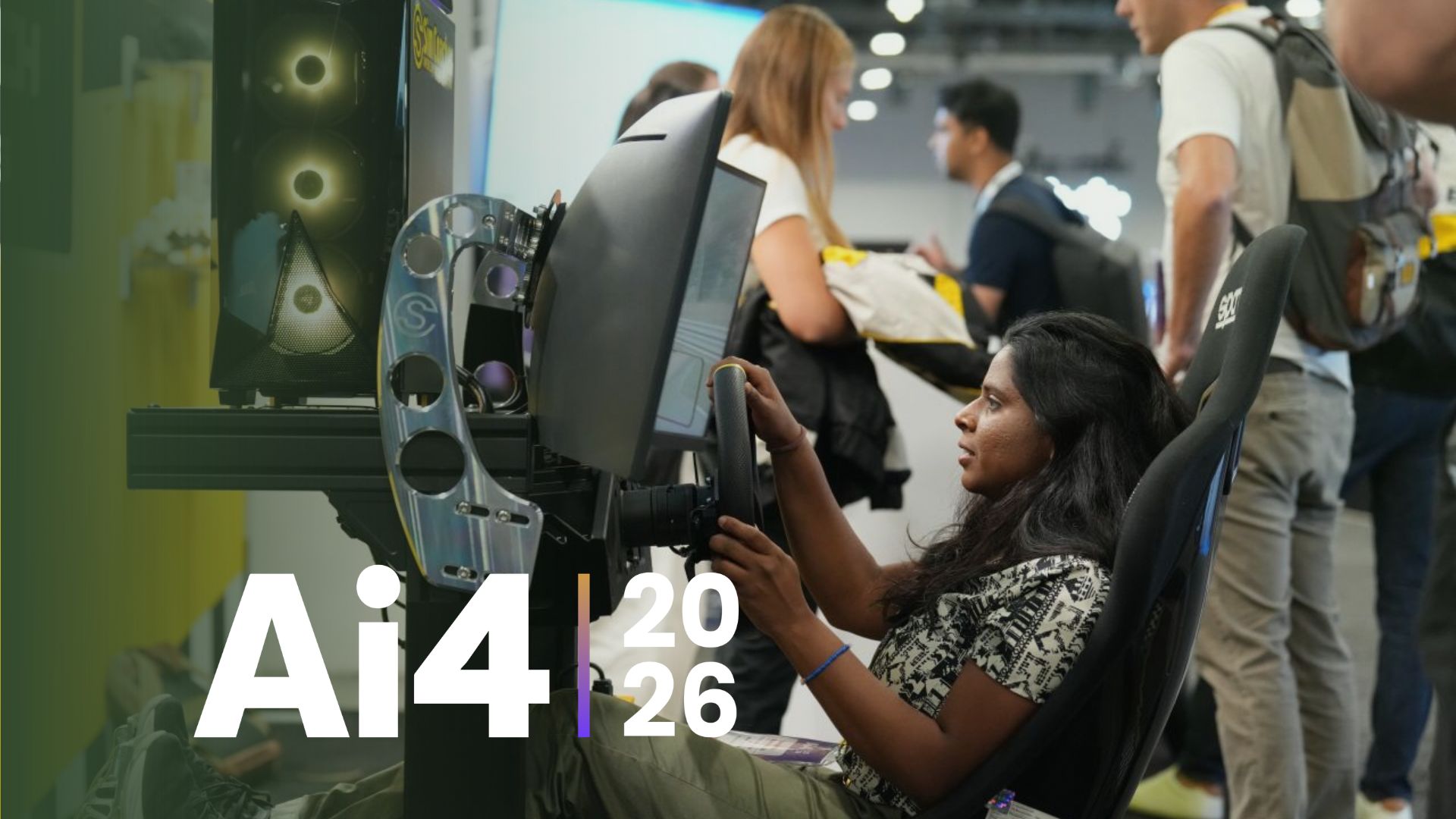
The energy at the SymTrain booth was strong throughout the conference. The large-format demos created natural stopping points, with people pausing mid-floor to watch, then staying to ask questions. Live demonstrations ran continuously, giving every conversation something concrete to react to rather than just slides and positioning. There was traffic from people who didn’t know us, but also current customers who stopped by and brought colleagues with them. There’s no better signal that a product is resonating than customers who voluntarily advocate for it in public. We saw a lot of that this year.
Why This Matters
The contact center industry is moving deliberately, and now with real momentum, toward a new operating model:
- AI that supports and amplifies people, not replaces them
- Data that drives action, not just reporting
- Ecosystems built on partnership, not platform consolidation
- Practice that runs continuously, not just at the start of a career
- Conversations that start with outcomes, not features
That’s not a description of where the industry is going. It’s a description of where it’s already arriving. CCW Vegas 2026 made that visible in a way that four days in a conference hall rarely does.
Looking Ahead
CCW Vegas reaffirmed something we’ve believed for a long time: technology alone doesn’t transform customer experience. People do.
The organizations that outperform in the years ahead won’t simply invest in more AI. They’ll invest in helping their people use it confidently, consistently, and effectively, building practice into how the work actually happens, connecting coaching to real performance data, and treating workforce development as a continuous capability rather than a periodic event.
We came back from Las Vegas energized. The conversations were better than they’ve been in years. The questions buyers are asking match the solutions we’ve been building. And the partnerships forming across the ecosystem are creating real value for organizations that deserve better tools. We’re excited to continue building that future alongside our customers and partners.
See you at the next CCW!
Want to see what continuous coaching looks like in practice?
See how SymTrain works to move your organization from one-time training events to continuous workforce development.