Coaching is everywhere. Real development is not.
Organizations have invested heavily in all sorts of tools, so now managers have more data about their people than ever before
- call metrics
- QA scores
- sentiment analysis
- productivity trends
Yet despite all of this visibility, many employees still feel stuck, overwhelmed, or disconnected from purpose, but the problem isn’t a lack of information. It’s a lack of transformation. Knowing what is happening doesn’t automatically change how people show up. And this is where modern coaching done well matters more than ever. (Related: Learn how to go from an idle knowledge base to an active one.)
The Coaching Gap in Modern Workplaces
Most organizations don’t suffer from a coaching shortage. They suffer from a coaching activation gap.
Conversations happen. Feedback is given. Action plans are documented. But too often, development stalls between insight and behavior. Employees hear the message, nod in agreement, and then return to the same systems, pressures, and habits that shaped their performance in the first place.
In high-pressure environments like customer experience and contact centers, this gap is even more visible. Leaders are expected to coach at scale while juggling performance targets, staffing challenges, and constant change. The result is coaching that is well-intentioned, but episodic, reactive, and difficult to sustain.
To close this gap, coaching has to evolve. Not into something softer or less rigorous, but into something more human, more practical, and more connected to how people actually learn and change.
What Separates Good Coaches from Great Ones
In a recent Coach’s Corner conversation, leadership coach and consultant Kirsten Penaloza shared insights that get to the heart of what modern coaching gets right, and where many approaches fall short.
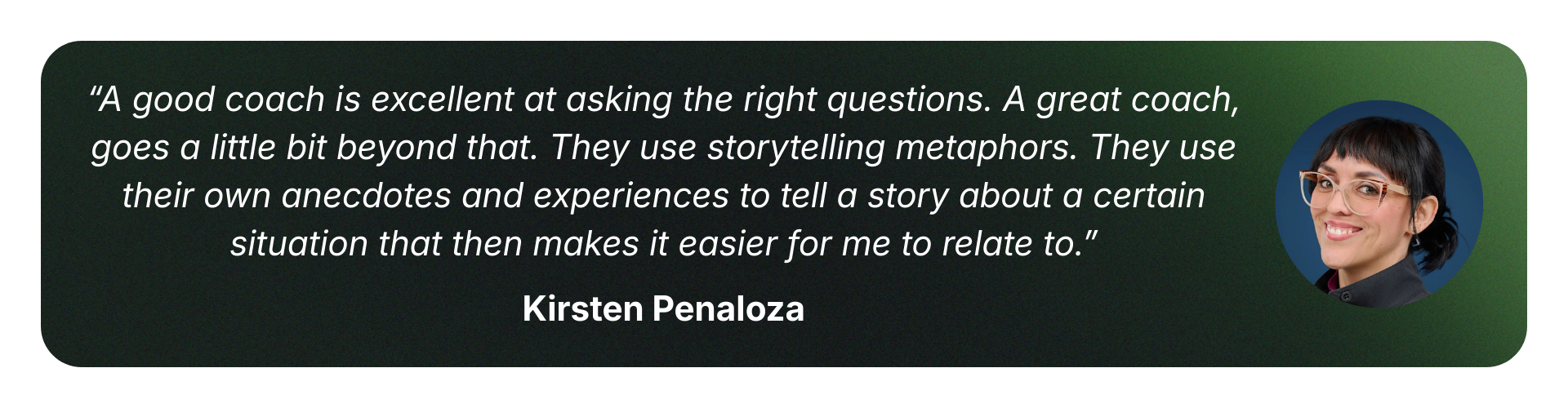
One of her strongest observations is that great coaching goes beyond asking the “right” questions.
Questions matter. Reflection matters. But questions alone don’t create movement.
Great coaches:
- Use storytelling to build trust and relevance
- Draw on lived experience instead of abstract theory
- Use metaphors to make complex dynamics relatable
- Adapt their approach beyond rigid coaching frameworks
In other words, modern coaching is about meeting people where they are and helping them see themselves, their challenges, and their potential more clearly.
This isn’t “soft skills.” It’s applied leadership. And it becomes even more critical as teams navigate ambiguity, AI-driven change, and rising expectations with limited margin for error.
Stuck vs. Overwhelmed: A Distinction Leaders Often Miss
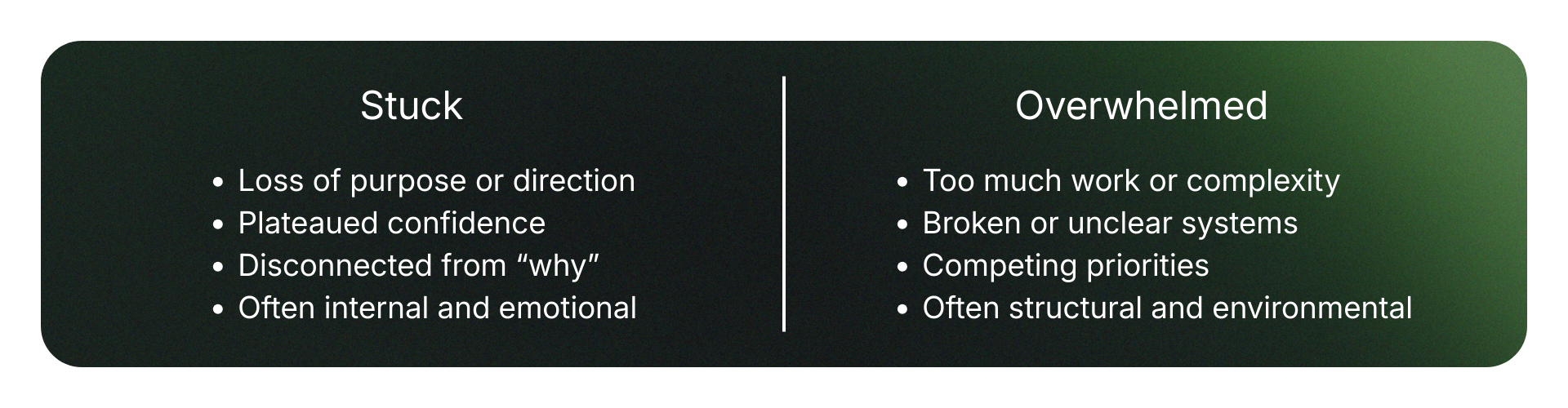
One of the most powerful insights from Kirsten’s coaching work is a distinction many leaders overlook: stuck is not the same as overwhelmed.
They can look similar on the surface, but they require very different responses.
- Stuck often signals a loss of purpose, confidence, or perspective. People feel plateaued, unsure of direction, or disconnected from why their work matters.
- Overwhelmed is usually systemic. Too much work, unclear expectations, broken processes, or competing priorities are draining energy and focus.
When leaders treat these states as interchangeable, coaching misses the mark.
If someone is stuck, they don’t need more process; they need reconnection to values, strengths, and meaning.
If someone is overwhelmed, no amount of motivation will help until the system itself is addressed.
This distinction aligns closely with a broader truth in performance management: most issues are not individual failures. They’re signals from the system. Effective coaching recognizes the difference and responds accordingly.
Human-Centered Leadership Without Lowering the Bar
At the core of Kirsten’s philosophy is a belief many leaders struggle to reconcile: you can care deeply about people without lowering standards.
Human-centered leadership doesn’t mean avoiding accountability. It means connecting accountability to purpose. Kindness is not the same as being “nice.” Being nice avoids hard conversations. Kind leadership has them with clarity and respect.
Kirsten often speaks about the importance of “connecting the dots” for people:
- Why expectations exist
- How their role contributes to broader outcomes
- Where growth aligns with both individual and organizational goals
This approach is shaped by her own experience, across countries, cultures, and leadership contexts, and by mentors who demonstrated that performance and humanity are not opposing forces. When leaders take the time to explain the why, people don’t just comply. They commit.
This is the foundation of sustainable performance, especially in environments where burnout and attrition are constant risks.
Where Data and AI Actually Belong in Coaching
Data has transformed leadership visibility. AI has accelerated it.
But visibility alone doesn’t equal development.
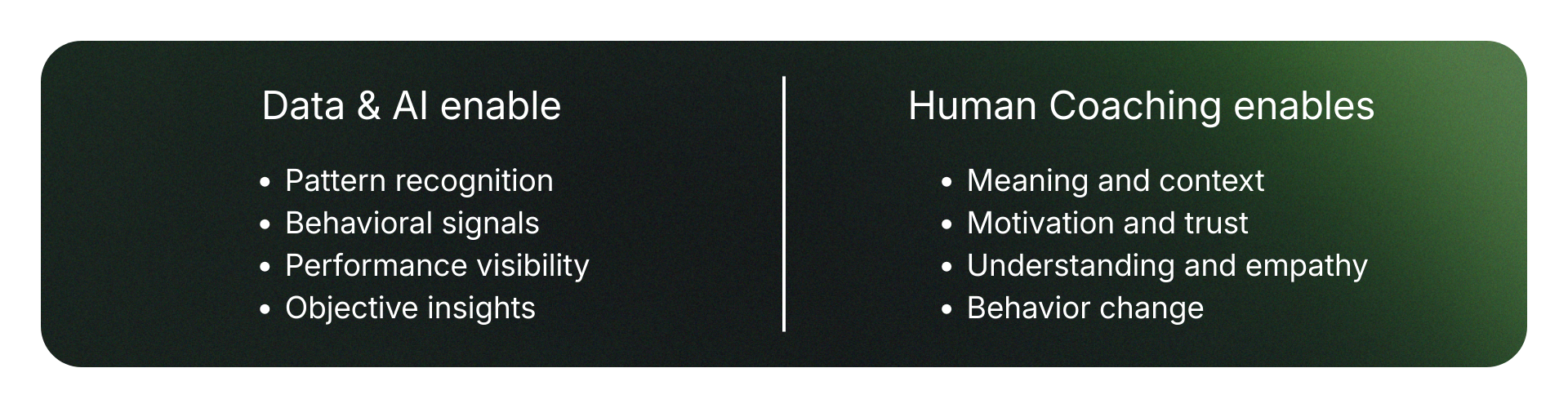
Used well, data reduces subjectivity. AI surfaces patterns humans might miss: behavior trends, skill gaps, and recurring friction points. These insights are invaluable. They create a shared, objective starting point for coaching conversations.
But they are not the conversation. As Kirsten notes, data shows what is happening. Coaching explores why it’s happening and what to do next.
The danger isn’t AI replacing coaches. The danger is organizations mistaking insight for impact. Without interpretation, context, and emotional intelligence, even the best data stays static.
Modern Coaching: From Insight to Action
This is where many training and coaching efforts break down.
Insight without practice doesn’t change behavior. People don’t build confidence by understanding expectations; they build it by rehearsing responses, testing judgment, and learning through repetition in realistic conditions. Coaching conversations create awareness and direction, but what determines whether change actually sticks is what happens after the conversation.
This is where practice becomes essential. Between coaching sessions, people need a way to apply feedback, experiment with new behaviors, and make mistakes without real-world consequences. Without that reinforcement, even strong coaching insights tend to fade under pressure.
This is where AI simulation training plays a critical, yet supportive, role. Rather than replacing human coaching, simulation acts as the practice layer by:
- Turning coaching feedback into realistic scenarios
- Reinforcing desired behaviors in a safe environment
- Allowing people to learn, test, and adapt through repetition without any risk to customers, teams, or outcomes
At SymTrain, simulations are designed to extend coaching beyond the conversation, not override it. They help operationalize coaching philosophies by giving people the space to practice what they’re working on, so insight turns into confidence, and confidence turns into consistent performance.
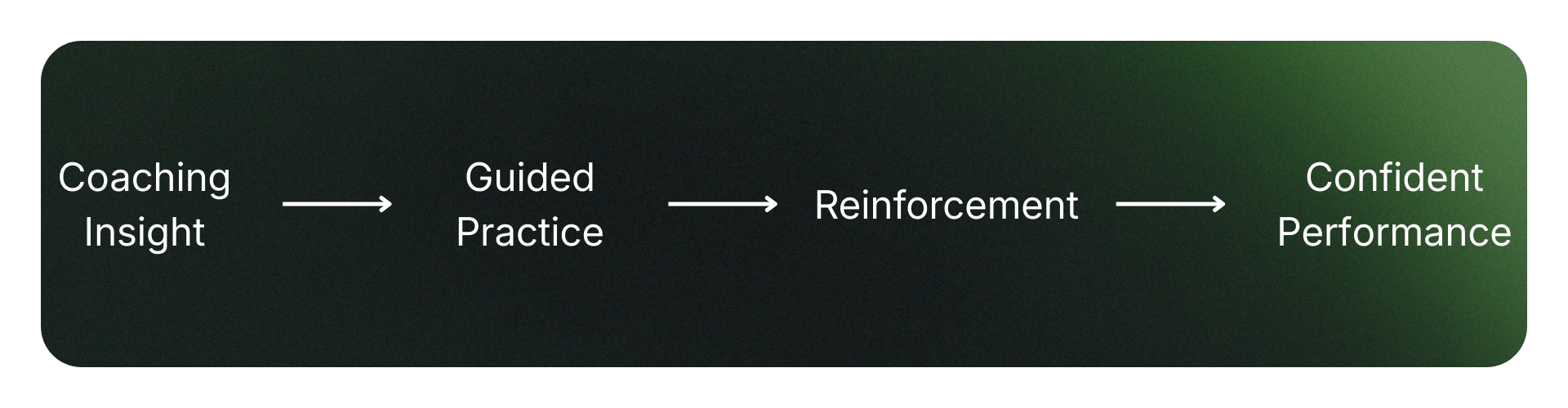
When insight is paired with practice, development sticks.
Learn About Kirsten Penaloza
Kirsten Penaloza brings more than a decade of experience across customer experience, operations, and people leadership, shaped by a deliberately non-linear, global career.
Having lived and worked across multiple countries and cultures, and fluent in English, German, and Spanish, Kirsten supports leaders navigating complexity, change, and growth. Her work sits at the intersection of operational excellence and human-centered leadership, helping organizations improve performance without sacrificing trust, empathy, or culture.
As a consultant and coach, she partners with senior leaders, emerging leaders, and organizations to translate values into action, systems into sustainable results, and insight into real behavioral change.
You can learn more about her work at Kirsten Penaloza’s consulting and coaching practice.
Coaching That Sticks
Modern coaching works when people:
- Understand their why
- Have space to practice new behaviors
- Feel supported by systems, not judged by them
In a world defined by rapid change and constant pressure, the goal isn’t more feedback, more tools, or more data. The goal is development that lasts. That happens when human insight and intelligent systems work together.
Want to hear more of Kirsten’s perspective? Listen to the full Coach’s Corner episode.